
RM6376 and RM6238: Education Recruitment Margin Caps Have Arrived. Your Profits Don’t Have To Shrink
RM6376 & RM6238 Margin Caps Are Here. So Where Do Education Recruiters Find Their Profit?
If you’ve recently secured a place on RM6376 or RM6238, congratulations.
It’s a significant achievement and one that doesn’t come easily.
Financial stability, safeguarding, governance, compliance, operational capability and pricing transparency all come under scrutiny. Securing a place on either framework demonstrates that your business can operate at the standard schools, Multi Academy Trusts and public sector organisations expect.
However, for many education recruitment businesses, winning a place on the framework is only the beginning.
The conversation we’re having most often at the moment isn’t about compliance.
It’s about profitability.
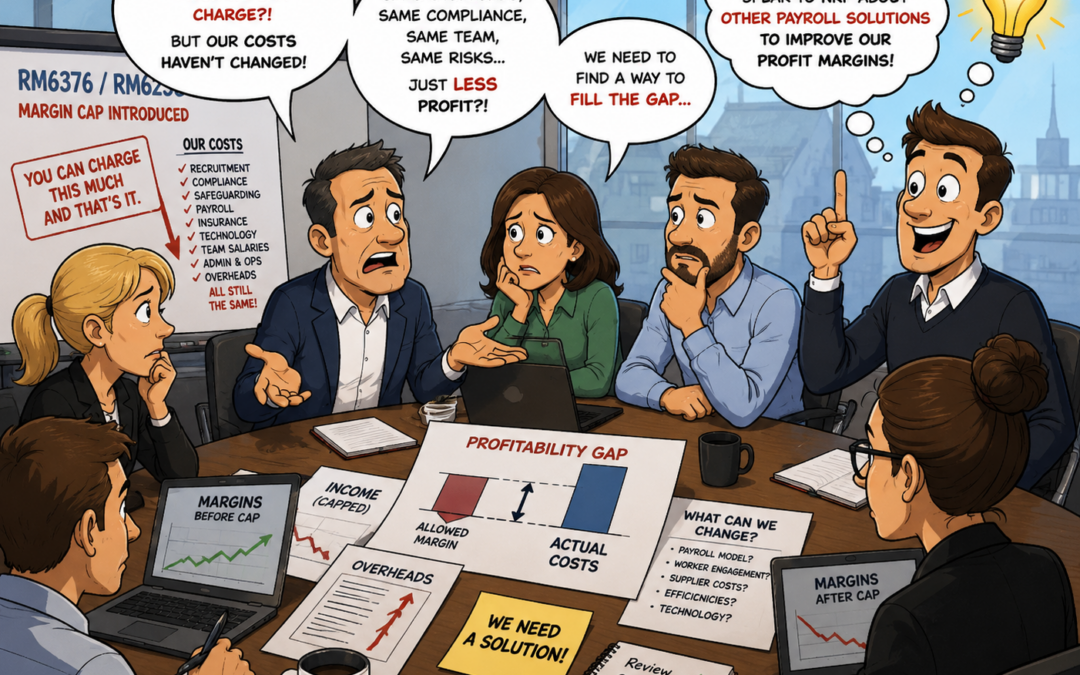
The Work Hasn’t Reduced. The Margin Has.
Most agency owners understand why margin caps have been introduced across RM6376 and RM6238.
Schools are under pressure.
Budgets are tighter than ever.
Procurement teams are being asked to demonstrate value and control costs wherever possible.
The challenge is that whilst the frameworks may cap what agencies can charge, they don’t reduce the cost of running a compliant recruitment business.
- You still need to attract candidates.
- You still need to manage safeguarding.
- You still need to support schools.
- You still need to pay workers accurately and on time.
- You still need to stay compliant.
The work hasn’t reduced.
The margin has.
It’s no surprise that many agency owners are now asking the same question:
“How do we protect profitability without increasing risk?“
Is Bringing Payroll In-House The Answer?
One of the first options many businesses consider is bringing payroll in-house.
On the surface, it makes sense.
If margins are being squeezed under RM6376 and RM6238, surely removing third-party costs is the answer?
Sometimes it is.
Often it isn’t.
What many businesses quickly realise is that payroll isn’t just payroll anymore.
When workers are employed directly by the agency, the responsibilities that come with employment sit with the agency too.
That means considering:
- Payroll governance
- HMRC reporting obligations
- Employment rights
- Compliance monitoring
- Operational administration
- Joint & Several Liability considerations for your end clients
With employment legislation continuing to evolve, particularly around day one worker rights, many agencies are understandably cautious about taking on additional responsibility unless the commercial benefit is clear.
For some businesses, bringing payroll in-house works well.
For others, it creates more cost, complexity and risk than expected.
The Conversation Has Changed
Historically, many recruitment businesses selected a payroll model years ago and simply stuck with it.
There was often little reason to review it.
Margins were healthy.
The process worked.
Everyone moved on.
The introduction of RM6376 and RM6238 margin caps is now encouraging agency owners to revisit decisions that may not have been reviewed for years.
Questions such as:
- Is our current payroll model still the most efficient?
- Are there alternative worker engagement models available?
- Could we improve profitability without disrupting operations?
- Are we carrying unnecessary employment risk?
- Are we getting the best commercial outcome from our workforce model?
These are exactly the conversations we’re having every day.
There Isn’t A One-Size-Fits-All Solution
At New Red Planet, we’ve worked alongside education recruitment businesses operating on CCS frameworks for more than a decade.
Today, more than 30 suppliers across RM6376 and RM6238 utilise our services.
One thing we’ve learnt during that time is that no two agencies are the same.
That’s why we don’t believe every business should be pushed towards a single payroll solution.
- Some businesses are best suited to an Umbrella model.
- Others benefit from PEO PAYE.
- Some prefer a PAYE Bureau solution.
- Many operate a combination of different engagement models.
The right answer depends on your objectives, your workforce, and how your business operates.
What often surprises agency owners is how much difference a relatively small change can make.
In many cases, improving profitability isn’t about making wholesale changes to the business.
It’s about reviewing a process that may not have been challenged for years and identifying opportunities that have previously been overlooked.
The Agencies That Thrive Will Be The Agencies That Adapt
The agencies that continue to succeed under RM6376 and RM6238 won’t necessarily be those charging the highest margins.
- They’ll be the businesses that understand their costs.
- The businesses that operate efficiently.
- The businesses that have visibility.
- And the businesses that are prepared to adapt when market conditions change.
The frameworks have undoubtedly changed the landscape.
But they haven’t removed opportunities.
They’ve simply encouraged agencies to look at areas of their business that may not have needed attention before.
Let’s Have A Conversation
If you’re reviewing how workers are engaged, how payroll is delivered or whether there are opportunities to improve efficiency and profitability within your existing model, we’d be happy to share what we’re seeing across the education recruitment market.
After supporting CCS framework suppliers for many years, we understand the challenges agencies face and the practical solutions many are implementing to adapt successfully.
Your margin may be capped.
Your options aren’t.