0161 713 1730
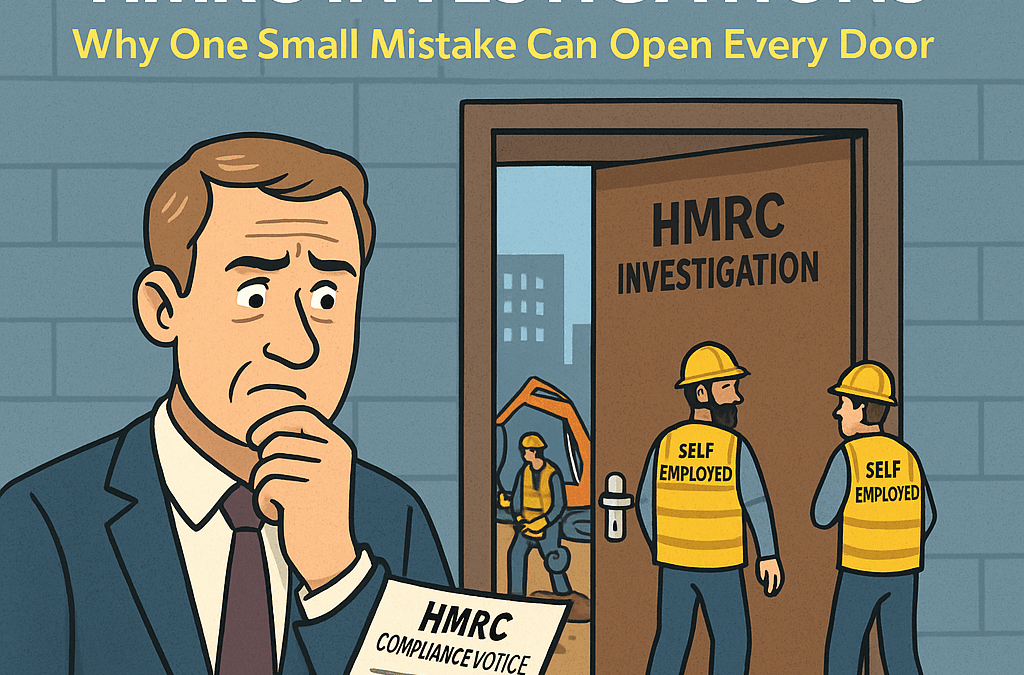
HMRC Investigations – Why One Small Mistake Can Open Every Door

HMRC Investigations – Why One Small Mistake Can Open Every Door

NRP Compliance Series – Protecting Construction and Civil Engineering Firms from Hidden Payroll and Employment Risks

Post 2: HMRC Investigations – Why One Small Mistake Can Open Every Door

When HMRC finds an irregularity in labour payments or status checks, it rarely stops there.

How it starts

It might begin with something minor. A sole trader’s tax return doesn’t match your records, or a missing verification raises a flag. Once that happens, HMRC may request information on every individual you’ve paid.

What happens next

They may review contracts, invoices and working arrangements to decide whether those sole traders were genuinely self-employed. They can also contact workers directly to confirm how the relationship operated day to day.

If HMRC believes control or dependency exists, it can reclassify those workers as employees and issue a compliance notice.

The knock-on effect

An investigation can quickly expand to include PAYE, VAT, Pensions Auto-Enrolment or even directors’ personal tax affairs. In some cases, businesses have also lost CIS Gross Payment Status, which can damage cash flow.

How to reduce your exposure

When workers are engaged through NRP, all verification and compliance checks are handled under a CIS structure managed by NRP.
We ensure accurate submissions, provide a complete audit trail, and maintain transparent records that satisfy HMRC scrutiny.

Your workers stay self-employed, your projects continue without disruption, and your business remains fully compliant.

CASE STUDY – False Self-Employment in the construction industry

Next up – Post 3: Employment Law Exposure – When Self-Employed Workers Start to Look Like Employees


Contact Steve McDermott if you would you like to know a little more about the risk and benefit of outsourcing you contractor payroll, and have No-obligation chat:

steve.mcdermott@newredplanet.com or 07854 881 220 or 0161 713 1730

Find out more

If you would like to know more about New Red Planet Products or services, request an information pack by completing the quick form below

7 + 13 =

Misclassification Risk – When “Self-Employed” Isn’t What HMRC Thinks

Misclassification Risk – When “Self-Employed” Isn’t What HMRC Thinks

NRP Compliance Series – Protecting Construction and Civil Engineering Firms from Hidden Payroll and Employment Risks

Post 1: Misclassification Risk – When “Self-Employed” Isn’t What HMRC Thinks

Many construction and civil engineering firms use self-employed sole traders for project work. It feels simple, flexible, and familiar, but it can quickly become a problem if those workers are not genuinely self-employed in HMRC’s eyes.

What the issue is

HMRC focuses on how people actually work, not just what the contract says. If a sole trader is working under supervision, direction, and control, HMRC may decide they are really an employee.

When that happens, the company becomes responsible for unpaid PAYE, National Insurance, and penalties because those individuals should have been on PAYE rather than paid as self-employed.

What this looks like in real life

If your site team wears your PPE, follows your site manager’s instructions, uses your equipment, and works set hours, HMRC could class them as employees. That can mean several years of backdated tax, NI, and fines.

The financial impact

Even a small reclassification can snowball. Once one worker’s status is questioned, HMRC often reviews your entire labour setup. The result can be a large tax bill and a serious compliance headache.

How to protect your business

By engaging self-employed workers through NRP’s CIS model, you gain the flexibility of self-employment with the safety of full HMRC compliance.

Workers remain self-employed, but NRP verifies, insures, and manages them under CIS rules, taking care of deductions, submissions, and records.

It keeps your structure flexible, your workforce compliant and your company protected.

Case Study: CIS – Disguised Self Employment in the Construction Industry

Next upPost 2: HMRC Investigations – Why One Mistake Can Open Every Door

Contact Steve McDermott if you would you like to know a little more about the risk and benefit of outsourcing you contractor payroll, and have No-obligation chat:

steve.mcdermott@newredplanet.com or 07854 881 220 or 0161 713 1730

Find out more

If you would like to know more about New Red Planet Products or services, request an information pack by completing the quick form below

2 + 12 =

Why are so many civil engineering and construction firms still paying contractors direct?

Why are so many civil engineering and construction firms still paying contractors direct?

NRP Compliance Series – Protecting Construction and Civil Engineering Firms from Hidden Payroll and Employment Risks

NRP Compliance Series – Protecting Construction and Civil Engineering Firms from Hidden Payroll and Employment Risks

It’s one of the biggest compliance blind spots in the industry.

In construction and civil engineering, the line between self-employment and employment has become increasingly blurred. Many firms still believe their contractor setup is compliant because they pay workers as self-employed, but HMRC and employment tribunals often take a different view.

This series has been created to help you understand where the real risks lie when engaging self-employed workers directly, and how to stay compliant while keeping the flexibility your business needs.

Over the coming weeks, we’ll look at the key compliance areas that regularly catch companies out and explain how NRP’s model provides a simple, safe, and cost-free solution.

You’ll learn:

  1. How misclassification can lead to unexpected PAYE and NI liabilities.
  2. Why an HMRC investigation can expand far beyond one issue.
  3. How employment law exposure can lead to backdated claims and tribunal costs.
  4. And how using NRP’s CIS compliance model removes those risks, without adding cost to your business

If you currently pay self-employed sole traders directly, these insights could protect your company from serious tax and employment problems.


Starting with Post 1: Misclassification Risk – When “Self-Employed” Isn’t What HMRC Thinks.


Contact Steve McDermott if you would you like to know a little more about the risk and benfit of outsourcing you contractor payroll, and have No-obligation chat:

steve.mcdermott@newredplanet.com or 07854 881 220 or 0161 713 1730

Find out more

If you would like to know more about New Red Planet Products or services, request an information pack by completing the quick form below

14 + 6 =

Joint and several liability (JSL) is coming for the temporary labour market.

Joint and several liability (JSL) is coming for the temporary labour market.

Joint and several liability (JSL) is coming for the temporary labour market.

What is changing regarding JSL …and what it means for recruiters.

Joint and several liability (JSL) is coming for the temporary labour market.

From April 2026, agencies and end-clients that use non-compliant umbrella companies could face shared liability.

If you recruit contractors, this is a compliance moment you can’t ignore.

What changes for recruiters?

  • More scrutiny
  • Tighter regulations
  • Liability across the supply chain

That’s why accreditation matters.

New Red Planet Ltd (NRP) is an FCSA-accredited payroll provider, giving partners confidence they’re working with a fully compliant, audited company.

The latest Recruiter magazine (page 4) echoes the point:

“Compliance is no longer optional, and old blind spots in the supply chain are being eliminated.”

I’m already speaking with recruiters who are mapping their risk. The priority now is to review your payroll supply chain and partner only with accredited providers.

How NRP helps

We support Umbrella, PAYE, PSC, Ltd Co, Bureau and outsourced back-office services.

That means you don’t have to hire extra payroll staff, take on more compliance responsibility, or risk exposing yourself – and your end clients – to JSL by directly engaging contractors.

April 2026 sounds distant, but by preparing now, you can safeguard your business, protect contractors and reassure clients.

Get the ball rolling…

Have you audited your umbrella supply chain in the last 90 days? No-obligation chat: steve.mcdermott@newredplanet.com or 07854 881 220.

Find out more

If you would like to know more about New Red Planet Products or services, request an information pack by completing the quick form below

9 + 14 =

Could the UK Finally Abolish IR35? Why Single Worker Status Could Change Everything

Could the UK Finally Abolish IR35? Why Single Worker Status Could Change Everything

Could the UK Finally Abolish IR35? Why Single Worker Status Could Change Everything

Why IR35 Could Be Scrapped – And What Happens Next?

Could IR35 be scrapped? A bold question, but one that’s starting to feel less far-fetched. The UK government is considering a Single Worker Status (SWS) a reform that could overhaul employment law, simplify worker classifications, and potentially make IR35 redundant.

For freelancers, contractors, recruiters and businesses, this could be one of the most significant shifts in employment legislation in decades.

Single Worker IR35

What Is Single Worker Status and Why Does It Matter for IR35?

The government is exploring a move away from the current three-tier framework of employee / worker / self-employed. Instead, a new Single Worker Status would merge the “worker” and “employee” categories into one, granting stronger protections such as:

  • Holiday pay

  • Statutory sick pay

  • Minimum wage rights

  • Potential unfair dismissal rights

If implemented clearly, this reform could eliminate much of the ambiguity that drives IR35 disputes today. Many of the complex tests around control, substitution, and mutuality of obligation might no longer apply in the same way.

For the genuinely self-employed, the change could bring greater legal clarity, reducing the risk of misclassification and giving both clients and contractors more confidence in HMRC compliance.

The Political and Legal Complications

While the headlines suggest IR35 could be on borrowed time, the reality is more complex:

  • Consultation first – The government has promised a consultation on employment status reform by the end of 2025.

  • Not immediate legislation – The Single Worker Status is not part of the current Employment Rights Bill, but instead seen as a longer-term reform goal.

  • Definitional challenges – Where do you draw the line between “genuinely self-employed” and “worker”? Issues like substitution clauses, level of control, and tax alignment remain contentious.

  • Parliamentary hurdles – Any reform would face debates, amendments, committee scrutiny, and potential pushback from both worker groups and business lobbies.


Potential Timeline for IR35 Reform

Stage Estimated Timescale
Consultation on employment status By end-2025
Stakeholder input & refinement 2026
Drafting legislation 2026–2027
Parliamentary debates & passage 2027–2028 (or later)
Implementation Earliest 2028–2029, more likely end of the decade

In other words, while IR35’s abolition is possible, it’s unlikely to happen overnight.

What Freelancers, Contractors & Recruiters Should Do Now

While the legislative gears turn slowly, the smartest move is to prepare early.

The first thing to do is to stay alert and keep an eye out for the consultation in 2025.

When it opens, be ready to review the details and contribute your perspective.

It is also worth carrying out an audit on your contracts. Take time now to review existing terms and check that they remain compliant under the current IR35 rules.

Clarify engagements with clients, making sure roles are well defined – particularly when it comes to substitution, control, and financial risk.

Finally, seek professional advice.

Speaking with experts in tax, payroll, and employment law will give you confidence and help protect your business.

    Could IR35 Really Be Abolished?

    Yes – the introduction of a Single Worker Status could eventually render IR35 redundant. But reform is years away, subject to political negotiation, and far from guaranteed.

    One thing is certain: the recruitment and contracting world cannot afford to ignore it.

    At NRP, we cut through the noise and track every development in employment law, recruitment legislation, payroll and compliance so you don’t have to.

    We’ll be keeping an eye on this development of course, and we’ll be ready for the day IR35 might finally be torn up.

    Find out more

    If you would like to know more about New Red Planet Products or services, request an information pack by completing the quick form below

    4 + 15 =