0161 713 1730
When Strength is Show, The Message is Clear

When Strength is Show, The Message is Clear

When Strength is Shown, The Message is Clear

Global Signals of Strength

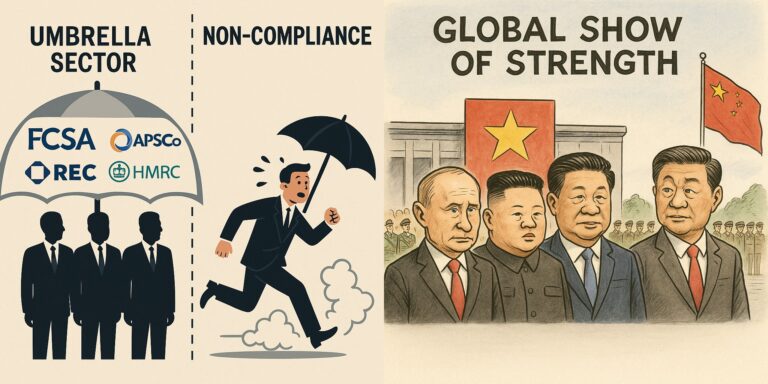
This week, Putin and Kim joined Xi and other Eastern leaders at China’s Victory Day celebrations. The event was a carefully staged display of unity and power aimed squarely at the West. Whatever your politics, the symbolism was clear: we’re aligned, and we’re ready if challenged.

Parallels at Home

Closer to home, I can see a similar pattern in our industry. The new umbrella legislation comes into effect in April 2026 and organisations like FCSA, REC, APSCo, and HMRC now stand shoulder to shoulder.

Together, they are sending a clear message to non-compliant umbrella companies: the era of looking the other way is over.

Resolve in Compliance

Global leaders show resolve through public alignment. Our sector’s leading bodies now do the same. They are ready to engage, act, and enforce compliance.

The Question Ahead

Will non-compliant companies adapt? Or will they keep running until HMRC arrives, only to vanish in a puff of smoke — as has happened before?

Global show strength

The Real Cost of Non-Compliance

When that happens, HMRC loses unpaid tax. But recruiters also suffer. Many have already paid wages to umbrellas, only to see the funds disappear.

In too many cases, recruiters pay workers twice – or worse, workers go unpaid.

Higher Stakes from April 2026

From April 2026, the risk increases further. Agencies could also be left covering unpaid monies owed to

HM Revenue & Customs. That threat should sharpen every recruiter’s focus on choosing compliant partners.

Why Unity Matters

A united stance protects everyone. Compliance is more than ticking boxes. It safeguards workers, recruiters, and the integrity of the supply chain.

Act Now, Not Later

Don’t wait until April 2026 catches you off guard. Book a call with New Red Planet today and let’s make sure your business is ready for the changes ahead.

Find out more

If you would like to know more about New Red Planet Products or services, request an information pack by completing the quick form below

15 + 1 =

UK Umbrella Payroll in 2025–26: Joint & Several Liability and Recruiter Risks

UK Umbrella Payroll in 2025–26: Joint & Several Liability and Recruiter Risks

UK Umbrella Payroll in 2025–26: Joint & Several Liability and Recruiter Risks

The UK umbrella payroll market in 2025–26: what joint & several liability means for recruiters (and why payment terms are now a red flag)

Key takeaway: From 6 April 2026, if an umbrella company in your supply chain fails to correctly operate PAYE/NIC, HMRC can recover the full debt from the recruitment business (or the end-client). That’s the new joint & several liability (JSL) regime now moving through the Finance Bill 2025–26 process.

Agencies must upgrade their umbrella due diligence and rethink commercial arrangements – especially payment terms, rebates and incentives – because those can create cash-flow pressure and increase the chance of non-compliance that lands back on you.

What’s changed?

  • New legislation: The government’s umbrella reform will make the employment business (or, where there’s no agency, the end-client) responsible for accounting for PAYE/NIC where an umbrella sits in the labour supply chain. Effective for payments made on/after 6 April 2026. 
  • Policy driver: HMRC’s response to widespread non-compliance in the umbrella market (e.g., disguised remuneration, mini-umbrella abuse). Government expects JSL to clamp down by shifting risk up the chain. Guidance around mini-umbrella fraud was also updated in August 2025.

Why this matters to recruitment companies

One of the biggest risks is that tax debt can quickly become your debt. If an umbrella company underpays or fails to hand over PAYE and National Insurance – whether on purpose or because of cash flow problems – HMRC can come after your agency for the whole amount. That includes interest and penalties, even if you’ve already paid the umbrella.

Supply chain checks are no longer optional

This is why supply chain checks can no longer be treated as a simple tick-box exercise. The old “preferred supplier list” checks won’t be enough. Agencies will be expected to show continuous monitoring, keep proper records, and act fast if an umbrella shows signs of non-compliance. Trade bodies and professional groups are already advising agencies to prepare in this way.

Protecting your reputation

There’s also the question of reputation. HMRC has been stepping up action against fraudulent umbrella arrangements, such as mini-umbrella schemes that exploit VAT rules or allowances. Payroll bodies are publicising recent cases, and any agency caught on the wrong side risks serious damage to its brand.

The hidden risks in umbrella payment terms

Another hidden risk comes from the commercial terms offered by umbrellas. Some providers tempt agencies with extended payment terms, rebates, marketing allowances or ongoing incentives. Under the new rules, these can all add to your exposure. Long payment terms or big rebates might look good on paper, but they can leave umbrellas short of cash to pay PAYE and NIC on time. If that happens, HMRC won’t hesitate to pass the bill on to your agency.

Incentives and poor practice

There’s also the problem of incentives being out of step with worker protection. Campaign groups and official guidance have both warned that agency kickbacks encourage poor practice in the umbrella sector and these are now seen as clear warning signs.

When a deal looks too good to be true

Finally, be wary of deals that seem too good to be true. If rates look unusually generous, ask; how the umbrella is funding statutory holiday pay, employer NIC, the apprenticeship levy, and pensions. With costs rising, especially employer NIC, an offer that looks unsustainable often points to corners being cut on tax.
    Bottom line: If you’re taking payment terms or rebates from your umbrella partner, you’re subsidised by the same cash that should be ring-fenced for PAYE/NIC. Under JSL, that’s your risk. 
    The UK umbrella payroll market in 2025–26: what joint & several liability means for recruiters (and why payment terms are now a red flag)

    What “good” looks like now (a recruiter’s checklist)

    Contracts & commercials

    • Remove or cap rebates, referral fees, “marketing support,” and extended payment terms. If you keep any, require the umbrella to maintain ring-fenced PAYE/NIC accounts and provide bank attestations. Document the rationale. 
    • Include JSL-ready clauses: right to audit in real time, information sharing, step-in/termination on compliance triggers, escrow/retentions tied to tax compliance certifications. (Take legal advice.)

    KYC & continuous monitoring

    • Verify the umbrella’s corporate identity, directors, VAT/PAYE registrations, and latest Companies House filings; monitor changes monthly.
    • Require evidence each pay cycle: RTI submissions, gross-to-net reports, pension files, and proof of PAYE/NIC remittance that reconciles to your worker population. Store this centrally with an audit trail. Sector guidance now stresses moving from “point-in-time” checks to ongoing ICAEW.
    • Watch for red flags: unusual take-home claims, offshore bank accounts, repeated advances, mini-umbrella patterns (multiple linked companies with near-identical names), and aggressive margin deals. Use HMRC’s updated mini-umbrella fraud checklist.

    Worker outcomes

    • Confirm correct operation of holiday pay, AWR parity, pensions auto-enrolment, and itemised payslips. Mistreatment here often accompanies tax non-compliance. Government’s umbrella initiative explicitly targets worker rights parity.

    Governance

    • Nominate a SMF/Senior Manager or director as supply-chain risk owner.
    • Run a JSL impact assessment on your temp book: quantify exposure by umbrella, sector and client; set concentration limits.

    What to tell clients and contractors

    • Clients: “From April 2026, if the umbrella fails, HMRC can come after us—or you if there’s no agency. We’ve tightened PSL standards, removed incentives, and implemented real-time payroll verification to protect the supply chain.”
    • Contractors: “We will only partner with umbrellas that evidence proper PAYE/NIC and worker rights. Any promise of inflated take-home is a red flag.” (Worker groups and HMRC warn that such claims often signal avoidance.) 
    Frequently Asked Questions
    Does JSL apply if there are multiple agencies in the chain?

    Yes—the agency with the direct contract with the end-client carries the responsibility; if there’s no agency, the end-client Effective for payments from 6 April 2026.

    Is this just HMRC “guidance”?

    The measure is set out in Finance Bill 2025–26 materials and GOV.UK policy papers; implementation is targeted for April 2026.

    Are mini-umbrella schemes still a thing?

    Yes, and HMRC has just updated its guidance—in August 2025—reinforcing checks agencies should complete and how to report suspected fraud.

    Action plan for the next 90 days

    1. Map exposure: list every umbrella on your PSL, associated volumes, and any commercial incentives/payment terms.
    2. Renegotiate: remove or limit incentives/extended terms; where retained, demand PAYE/NIC proofing and ring-fencing.
    3. Operationalise monitoring: implement pay-cycle evidence collection and reconciliation; set automated alerts for anomalies.
    4. Train consultants: make acceptance of gifts/rebates a disciplinary issue; refresh AML/ABAC and “speak-up” channels. Government messaging explicitly warns recruiters against inducements.
    5. Brief clients with a one-pager on your JSL approach and updated PSL criteria.
    6. Essential questions for Recruiters answered by Umbrella Man… Your Questions Answered – NRP 

    This blog is general information, not legal or tax advice. For specific scenarios, speak with your professional advisers.

    Find out more

    If you would like to know more about New Red Planet Products or services, request an information pack by completing the quick form below

    3 + 15 =

    Your questions answered about the new Umbrella Legislation and its impact on the recruitment sector

    Your questions answered about the new Umbrella Legislation and its impact on the recruitment sector

    Your questions answered about the new Umbrella Legislation and its impact on the recruitment sector

    Need Answers To Your Umbrella Legislation Questions?…

    Let our expert ‘Umbrella Man’ shed a light on several questions recruiters and end clients have asked about the legislation that comes into play on April 6th, 2026.

    Let’s hear what he has to say in response to your questions…

    Your questions answered about the new Umbrella Legislation and its impact on the recruitment sector - Umbrella Man superhero cartoon character in office
    What is the shift in risk and responsibility?

    The new legislation fundamentally shifts the responsibility for PAYE compliance up the labour supply chain, placing greater accountability on recruitment agencies.

    What is Joint and Several Liability?

    Recruitment agencies will become jointly and severally liable for unpaid PAYE if their partnered umbrella company fails to meet its tax obligations. This means HMRC can pursue the agency in the first instance for any unpaid amounts, even if the agency was not directly involved in the non-compliance.

    What is the increased burden on compliance?

    Agencies will need to significantly enhance their due diligence processes and ongoing monitoring of umbrella companies to ensure compliance and mitigate potential liabilities. This includes verifying their compliance status, reviewing detailed compliance documents, and auditing payslips and reconciliation statements.

    What is the potential rise in costs?

    The need for increased due diligence, compliance tools, and ongoing monitoring may result in higher operational costs for recruitment agencies.

    Could there be any reputational damage for getting it wrong?

    Agencies may face reputational damage if they are associated with non-compliant umbrella companies or those engaging in questionable pay practices.

    How do I navigate the new and complex regulatory landscape?

    The new legislation, alongside the Employment Rights Bill, creates a complex regulatory environment that agencies must navigate to ensure continued compliance.

    Umbrella superhero giving his thoughts on the umbrella legislation and employee rights bill

    Umbrella Man’s thoughts on tackling the legislation:

    1. Strengthen due diligence processes: Implement robust and continuous checks on umbrella companies, including using due diligence tools and verifying compliance certifications. FCSA members (New Red Planet Ltd is one) hold the highest level of compliance in the market.
    2. Partner with certified umbrellas: Prioritise working with independently certified and accredited umbrella companies (FCSA recommended companies such as New Red Planet) that can provide verifiable proof of compliance.
    3. Stay informed and engage with industry updates: Monitor updates from HMRC and industry bodies like the FCSA, REC, and New Red Planet Ltd website and LinkedIn page to stay ahead of regulatory developments.
    4. Proactive Approach: Begin preparing for the changes now, rather than waiting for the final implementation, to avoid potential financial and reputational risks. To stay ahead of the game and have a no obligation conversation with an FCSA Accredited member, just give New Red Planet Ltd a call or email on the details below.
    5. Consider Diversifying Candidate Payment Options: Explore alternatives to umbrella options, such as PEO or direct PAYE employment, to reduce exposure to the new risks associated with the legislation. New Red Planet Ltd can offer many options to our clients including outsourced payroll and Bureau options to reduce in-house employment, compliance and legal costs associated with bringing payroll inhouse.
    6. Centralise Documentation: Ensure contracts, payment records, and proof of PAYE compliance are accessible and consistent for potential HMRC inquiries.

    By implementing these measures, you can proactively manage the risks associated with the new umbrella company legislation, ensuring compliance, protecting your business, and building stronger relationships with both clients and contractors.

    Find out more

    If you would like to know more about New Red Planet Products or services, request an information pack by completing the quick form below

    3 + 12 =

    What Recruiters and End Clients really need to know about the Employment Rights Bill and Umbrella Legislation

    What Recruiters and End Clients really need to know about the Employment Rights Bill and Umbrella Legislation

    What Recruiters and End Clients really need to know about the Employment Rights Bill and Umbrella Legislation

    ERB - Employment Rights Bill 2026

    Significant Effects on Recruitment Firms:

    The Employment Rights Bill, along with Umbrella Company Legislation, seeks to enhance regulatory compliance and safeguard workers, including the recruitment industry and umbrella companies.

    A significant modification involves umbrella and agencies becoming ‘Joint and Severally Liable’ for PAYE (Pay As You Earn).

    This measure will commence in April 2026 and will allow HMRC to pursue an agency in the first instance for any payroll taxes that a non-compliant umbrella company fails to remit to HMRC on their behalf.

    It is also important to note that the end client will be liable if contracting directly with an umbrella company.

      Here’s an overview

      PAYE Accountability:

      • Legislation will be introduced in Finance Bill 2025-26 to amend part 2 of ITEPA 2003. The legislation will make employment agencies or end clients joint and severally liable for any amount required to be accounted for under the PAYE provisions where an umbrella company forms part of a labour supply chain.

      Classifying Umbrella Companies as Employment Businesses:

      • The Employment Rights Bill will establish a new definition for umbrella companies, placing them within the category of “employment business”. This change will enable the Fair Work Agency (once it is in operation) to regulate these companies. Workers hired through umbrella firms will receive the same rights and protections as those directly employed by recruitment agencies or end clients.

      Significant Effects on Recruitment Firms

      • Increased Compliance Expectations: Agencies will be required to implement effective compliance processes for individuals using umbrella companies.
      • Potential Rise in Costs: The need to ensure compliance and handle possible additional responsibilities may result in higher expenses for recruitment agencies.
      • Importance of Thorough Assessments: Recruitment agencies must perform meticulous due diligence on the umbrella companies they partner with to maintain compliance and mitigate potential liabilities.
      • Escalation of Regulations: Umbrella companies are likely to encounter more stringent scrutiny and regulation, which could influence their business operations.

      Additional Considerations:

      • The Employment Rights Bill is currently progressing through Parliament and is anticipated to be fully enacted by 2026.
      • Recruitment agencies and umbrella companies should remain vigilant regarding the bill’s advancement and forthcoming implementation.
      • Collaborative efforts between the government, recruitment firms, and umbrella companies will be essential for the smooth rollout of the new regulations.

      If you have any questions or concerns regarding the Employment Rights Bill, please don’t hesitate to get on touch on 0161 713 1730.

      Find out more

      If you would like to know more about New Red Planet Products or services, request an information pack by completing the quick form below

      7 + 5 =

      A guide to what impact the new Umbrella Legislation has on the Recruitment Sector

      A guide to what impact the new Umbrella Legislation has on the Recruitment Sector

      A guide to what impact the new Umbrella Legislation has on the Recruitment Sector

      Changes to the Umbrella Legislation – What has brought about the changes, and what will they mean?

      New Red Planet Ltd, an FCSA Accredited payroll company has prepared a brief overview of the impending new Umbrella Legislation changes and highlighted the possible impacts and benefits this has on the recruitment sector.

      On July 21, 2025, the Government released the long-anticipated draft legislation addressing the shift in PAYE responsibilities for recruitment agencies supplying workers through umbrella companies.

      What has brought about the changes?

      This initiative aims to combat tax evasion within the umbrella sector.

      These modifications stem from prior evidence gathering effort in 2021, which led to a consultation held in 2023 focusing on the regulation of umbrella companies for employment rights and strategies to address tax non-compliance in the sector.

      So, what implications does this change hold?

      Are you impacted by it?

      What steps should you take now?

      Additionally, how much time do you have to familiarise yourself with these updates?

      What recruiters need to know.

      The proposed Income Tax legislation issued by the government aims to hold recruitment agencies, in addition to the umbrella company, responsible for Pay As You Earn (PAYE) obligations, regarding payments made to workers supplied through umbrella companies.

      In cases where there is no recruitment agency involved, the ultimate client assumes this responsibility.

      This legislation establishes a framework of joint and several liability, enabling HMRC to seek recovery of payroll taxes that an umbrella company fails to remit, targeting either the agency or the end client.

      This initiative is designed to diminish instances of tax non-compliance, potentially generating an additional £500 million by the fiscal year 2029-30, while fostering fairness among compliant businesses and safeguarding workers from unexpected tax liabilities.

      Text saying time to take control

      Furthermore, the draft legislation introduces joint and several liability in cases involving so-called umbrella companies to address evasion of this responsibility.

      These scenarios arise when an individual is providing services to an end-user client but does not seem to be formally employed by the umbrella company.

      Employment agencies have the authority to determine which companies are permitted to join their labour supply chains, giving them the capability to block unauthorised entities from accessing the market.

      The government is of the view that holding those in control of labour supply chains legally accountable for the accurate reporting of PAYE will enhance compliance within the industry.

      Plus, the regulations specify that when an agency is involved, it will be regarded as the employer in cases concerning the failure to pay taxes, and HMRC will seek security from the agency for any unpaid PAYE obligations.

      Squiggle of year 2026 to represent the changes in Umbrella Legislation

      A draft of the legislation has been issued and will undergo a technical consultation that will continue until September 15, 2025, with the law set to come into force on April 6, 2026.

      The aim of this consultation is not to decide if the provisions should be enacted, but to ascertain if the draft meets its declared goals. Additionally, this consultation can uncover any potential unintended effects.

      In a different context, the Employment Rights Bill is set to introduce regulations that will subject umbrella companies to oversight by the Employment Agencies Standards inspectorate, followed by the Fair Work Agency in 2027.

      The government has introduced a legislative package that was largely anticipated, aimed at establishing Joint Several Liability (JSL) for clients utilising umbrella companies.

      In a recent note from the Finance Bill 2025-26 released yesterday, HMT states that recruitment agencies will bear the responsibility for PAYE concerning the wages of employees associated with umbrella companies. 

      As agencies assume the tax liability going forward, those opting to maintain partnerships with umbrella companies must be persuasive in encouraging these companies to facilitate real-time monitoring and verification of actual employee payslips and, ideally, provide proof that payments have been made to HMRC.

      What are the consequences and what is the meaning of joint and several liability?

      Joint and several liability refers to the principle that every participant in the supply chain shares equal responsibility for any underpayment, with any one of them being accountable for the total amount owed. This implies that HMRC is permitted to seek the full outstanding sum from any party, no matter what their involvement was in causing the underpayment.

      In theory, this suggests that any individual party could be held accountable for the entire PAYE underpayment associated with workers supplied by umbrella companies.  However, HMRC’s outlined policy and objectives indicate that initially, either the agency or the client will bear the responsibility for any tax deficiencies. For master vendors, the key takeaway is that the entity holding the contract with the client will carry the joint and several liability in situations involving umbrella companies within the supply chain.

      What's next for recruitment agencies

      Following the enactment of the new Finance Bill, it will be essential to verify that your processes align with compliance standards, as failing to do so could result in liability for any outstanding Pay As You Earn (PAYE) dues.

      Additionally, there are indications that regulations concerning National Insurance contributions may also be introducedIf you are currently utilising the services of an umbrella company for your workforce, this is an opportune moment to initiate conversations with these firms regarding their procedures concerning PAYE.

      All businesses dependent on umbrella arrangements should take this interim period to examine their supply chains, communicate with umbrella providers, and gain clarity on how they handle payroll compliance. It is recommended to initiate discussions early and provide sufficient time to decide upon and enact relevant action plans.

      At New Red Planet, we are proactively collaborating with FCSA and our recruitment and legal partners to prepare for forthcoming changes. This will ensure we are equipped to offer clients practical advice and resources aimed at minimising risk and ensuring compliance.

      Although the draft bill is not yet law, it is prudent to dedicate this time to gain a comprehensive understanding of PAYE regulations and to recognise how these rules may vary among different workforces.


      What the REC says

      • Continue to carry out due diligence on umbrella companies you use. REC members can access the REC’s model due diligence checklists here
      • Find out how your umbrella company partners are responding to the changes to inform your next steps

      Find out more

      If you would like to know more about New Red Planet Products or services, request an information pack by completing the quick form below

      12 + 7 =